|
|
Szombathely, 1942. |
|
Carvings of Marble
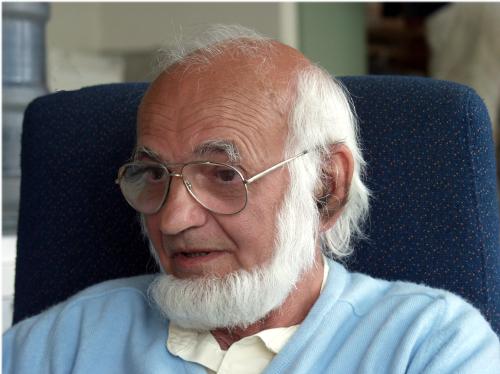
Gábor Czéh, MD, DSc is a Hungarian neuroscientist who has carved
marble and wood for more than 40 years. He has limited his audience
to friends, University colleagues and private showings in Hungary.
His works are shown here in the United States for the first time.
Some comments on his his own works:
I consider carving as art of stone, light and space. Stone may be
substituted by wood or other material, but light and space is needed
for a sculpture to reveal itself. Sculpting is traditionally regarded
as a form of art used to organize space and therefore the pieces need
dimensions around them. Painting and drawing arrange the plan - the
flat surface of a picture - and may suggest space. Carvings, however,
as well as architecture, make a strict order in space. Negative forms
are more intimate, protected parts of space within carvings while
positive forms can be open or closed. My carvings include both.
I use the technique called 'direct carving.' I take the stone with
only an obscure idea of what form can be hidden inside and try to free
it. Ideas keep changing as I progress, and perhaps never mature, never felt
complete or finished. In fact, all curves might be a bit more curved,
negatives a bit deeper or larger, surfaces flatter and more polished, and so
on.
The frequently used thin marble requires designs with dominant contours.
A technique I often incorporate is to sand a flat stone to an almost
transparent thickness, which creates a dramatic effect of positive and
negative in certain lighting arrangements. The stones shown are less then
about 40 cm high.
Most of my recent carvings are of marble from Carrara, Italy. This material
is often quite white, but marbles from another quarrels in the same region
are a bit darker, have traces of metallic inclusions creating streaks of grey
tones.
The rough edges of split marble have a natural texture which cannot be
produced by either hand or machine carving. This gives me an opportunity
to contrast man made surfaces with nature. Several carvings take advantage
of this contrast.
Compositions of more than a single stone present a challenge on how to
organize space, how to accent bordered emptiness. Negative forms in this
concept become more ambiguous as though melting into space while separating
and surrounding components. The number of possible combinations of two or
three pieces in space is endless. One of the styles I use is to put shaped
pieces together in a way so as to suggest form by adjacent surfaces which
would be impossible to make by directly carving. Another guideline is to
accent contrasts such as a white stone against a darker, tinted stone.
No carving can be perceived without light. Light in the dimension and
time of our daily life keeps changing, and thus carvings become almost alive
as their character is modulated from morning to night with the changing
natural light from various directions. Light is sometimes bright, sometimes
soft, gray and cloudy, warm red and yellow which all contribute to the
changing mood of carvings or your own mood as looking at them. Even
artificial light, dim light and candlelight each open up further dimensions.
Owning a piece of carved marble offers many little surprises day by day.
So enjoy it, discover it, let it be and love it.
Gábor Czéh