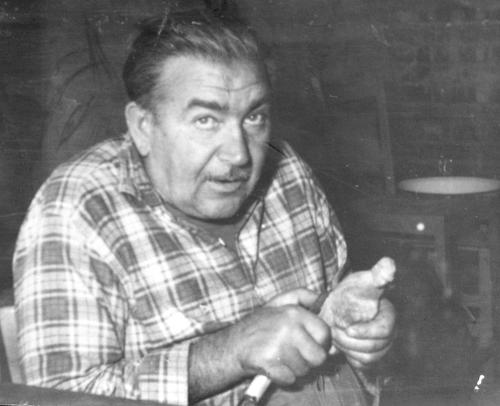
Bátaszék, 1909. - Szekszárd, 1993.
"He was born on 30th November 1909 in Bátaszék. Also he chose the trade of cartwrights inspired by the example of his ancestors, he knew and liked woods.
He was also shipman for four years, his carvings kept the memory of this.
In his childhood he would have liked to become a painter under the influence of the drawing-teacher Bellák Sándor. He wrote: "I should have liked to be a painter, but my father made averse to this aspiration of mine".
An increasing paralysis of his central nervous system has been beginning when he was he was twenty-seven, which appeared also in the deformation of hands. He began to carve in 1960, and this activity was a therapy for keeping him in life. "My only remedy is carving. I make carvings for my own pleasure. I had died long ago without carving." - he said in the winter of 1985.
At first he carved sticks, making sculptures on the grasps, e.g. representing a head of a duck catching a fish. Then he made sculptures of animals in the round. Then he soon changed over to represent human types of small size, he made sevaral hundreds of them in his life. In the very beginning he made them of hardwood, of pear, walnut and apple wood, of maple, thornapple and spindle-berry. But he could afford to carve works only of soft-wood at his life's end.
He never carved human figures to make portraits. He mainly carved in sculptures the observed moments of peasant life: herds, men with stick and bag, peasants with apron, human pairs, mother and child, fishermen and hadworkers, although he never carved naturalistic figures, he rather carved with summarizing concision."
Pál Bánszky: The wild flowers of fine arts
His creations can be observed based on preliminary cheque-in in Kozármisleny, the collection created by his foster daughter.
Contact: Vámosi IstvánnéKozármisleny
Móra Ferenc u. 43.
7761
Phone:+ 36 72/371-235
+36 20/616-5600 E-mail: vamosianci@citromail.hu
Fotó és összeállítás: Rühl Gizella képfeldolgozás: Hollendus János